
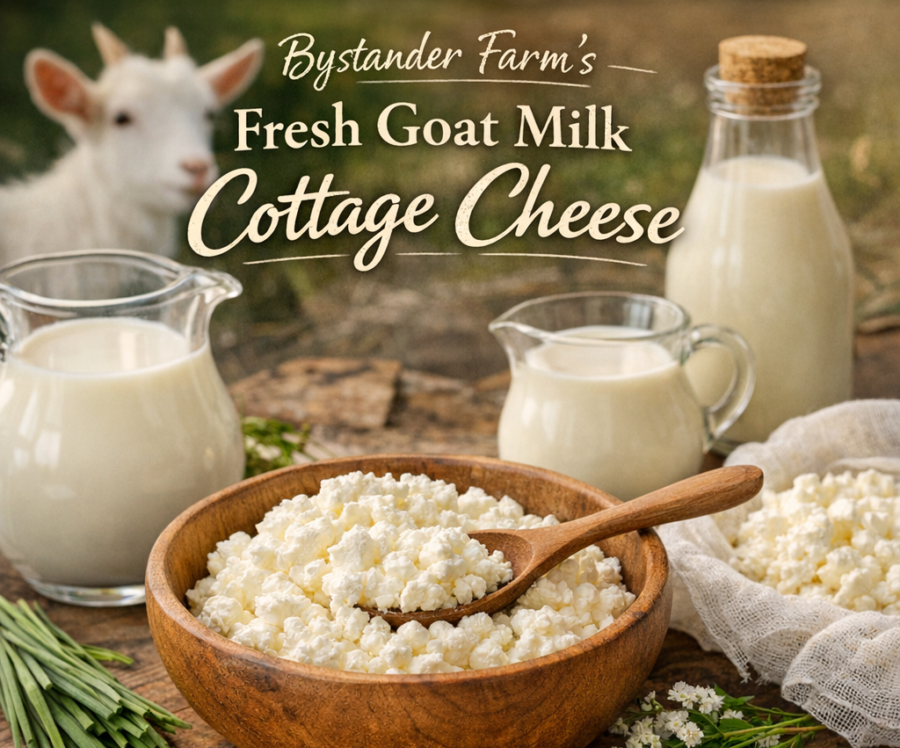
Two Ways: Cultured & No‑Culture, Both Beautiful
Cottage cheese is one of those cheeses that meets you exactly where you are, whether you’re a seasoned cheesemaker with cultures lined up in the freezer, or someone who just wants to turn a gallon of milk into something soft, fresh, and nourishing.
My challenge is always “How can we use all this milk?” After filling the fridge with cheese wheels of different varieties that are taking their time to age, I thought “what about cottage cheese?” It’s quick, gentle, and endlessly adaptable. And because goat milk has its own personality, delicate, bright, naturally homogenized, the cottage cheese you make from it will be softer, sweeter, and more tender than anything you’ve ever scooped from a store container.
Below are two versions for anyone with an abundance of milk:
- a cultured, rennet‑set cottage cheese for those who want a classic curd structure and mild tang
- a no‑culture, acid‑set version that anyone can make with nothing more than milk, vinegar, and a little patience
Both are beautiful. Both honor the milk. And both belong in your farm kitchen.
🧀 Version 1: Cultured, Rennet‑Set Cottage Cheese
Soft curds, clean flavor, gentle tang, perfect for fresh goat milk.
This is the cottage cheese that feels closest to the traditional style: distinct curds, mild flavor, and a texture that’s tender without being mushy. Goat milk makes it especially silky.
🥛 Ingredients
• 1 gallon fresh goat milk
• 1/8 tsp MA11 mesophilic culture
• 1–2 drops double‑strength rennet, diluted in 1/4 cup cool water
Goat milk needs very little rennet for cottage cheese
• 1–2 tsp non‑iodized salt
• Cream for dressing (goat cream if you have it, or a splash of half‑and‑half or whole milk – whatever you like.)
🔥 Equipment
• Large pot
• Thermometer
• Long knife or curd cutter
• Colander + butter muslin/Cheesecloth
• Slotted spoon or rubber/silicon spatula (spatula preferred – the metal is not gentle enough for this one)
🧭 Process
1. Warm the milk – if it’s just been milked you may be able to skip this step.
Heat your goat milk to 86°F.
Goat milk is sensitive so warm slowly and gently.
Once the target temp is reached stop the heat.
2. Add the culture
Sprinkle MA11 over the surface.
Let it rehydrate for 2 minutes, then stir in with slow up‑and‑down motions.
Ripen for 30 minutes:
- Cover the pot with a lid
- Wrap the covered pot in a towel large enough to insulate it from the A/C
- Keep the pot somewhere it won’t get jostled or moved around
This gives you the mild flavor cottage cheese needs.
3. Add the rennet
Dilute 1–2 drops of double‑strength rennet in 1/4 cup cool, non-chlorinated, water (I use distilled).
Add to the milk and stir gently for 20–30 seconds.
Then stop: goat milk curds break easily.
4. Let it set
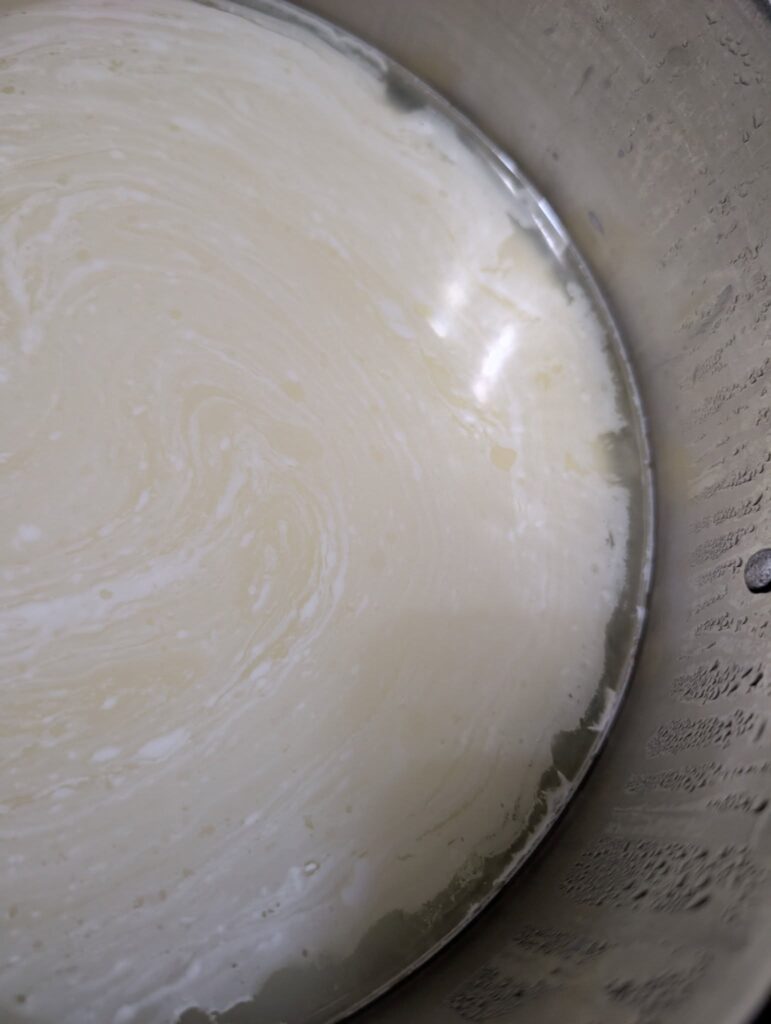
Put the cover on the pot and let sit 4–6 hours at 86°F – wrap it in the towel again and leave it where it will stay out of direct A/C and where it can remain totally still.
My goat milk is usually slow‑setting, so I don’t rush it.
You want a very soft gel that gives a clean break when lifted with a knife.
If it needs 7 hours, that’s fine, cottage cheese is forgiving. This is how it should look in the pot when it’s ready – lots of whey, one solid curd formation that has separated from the sides of the pot.
5. Cut the curd
Cut into 1/2‑inch cubes: cut straight down the center of the pot and then repeat in straight lines to the left and right of the center cut. Rotate the pot 90 degrees and repeat the same process. This will give you half inch columns of curd. Then take your knife on an angle and cut from the edge of the pot to the center in half inche swipes. Turn the pot a quarter and do it again – repeat until all the cheese has been horizontally cut. (Or if you have a curd harp use use that!).
Cover the pot and let the curds rest 20 minutes to firm slightly.
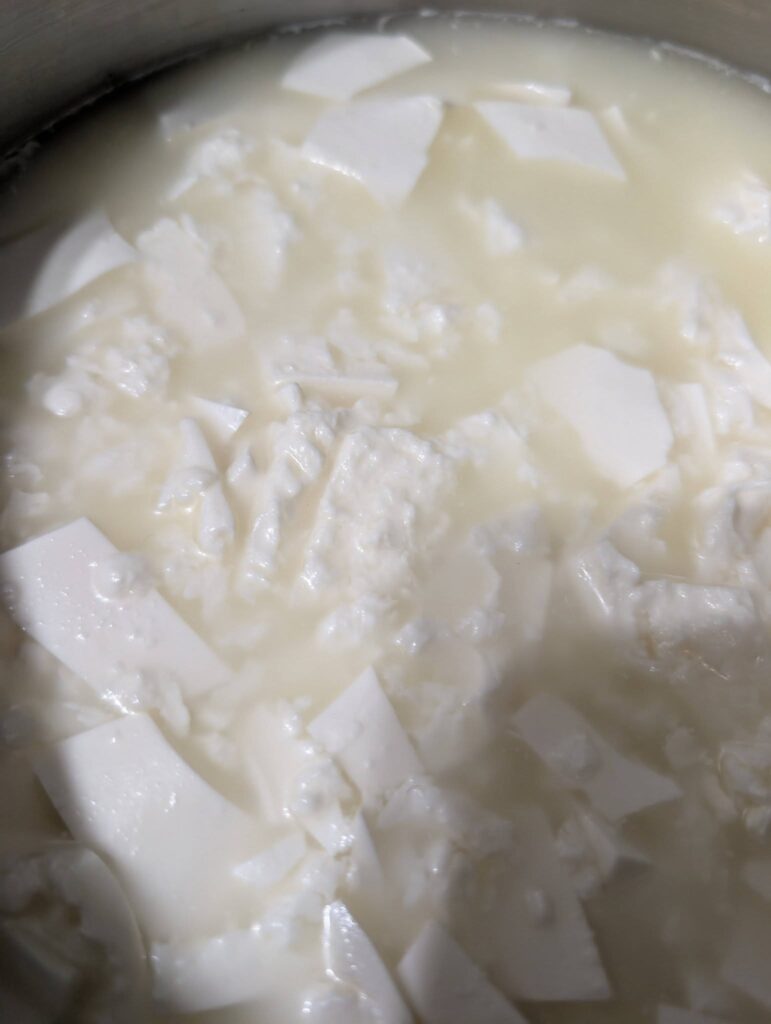
6. Cook the curds slowly
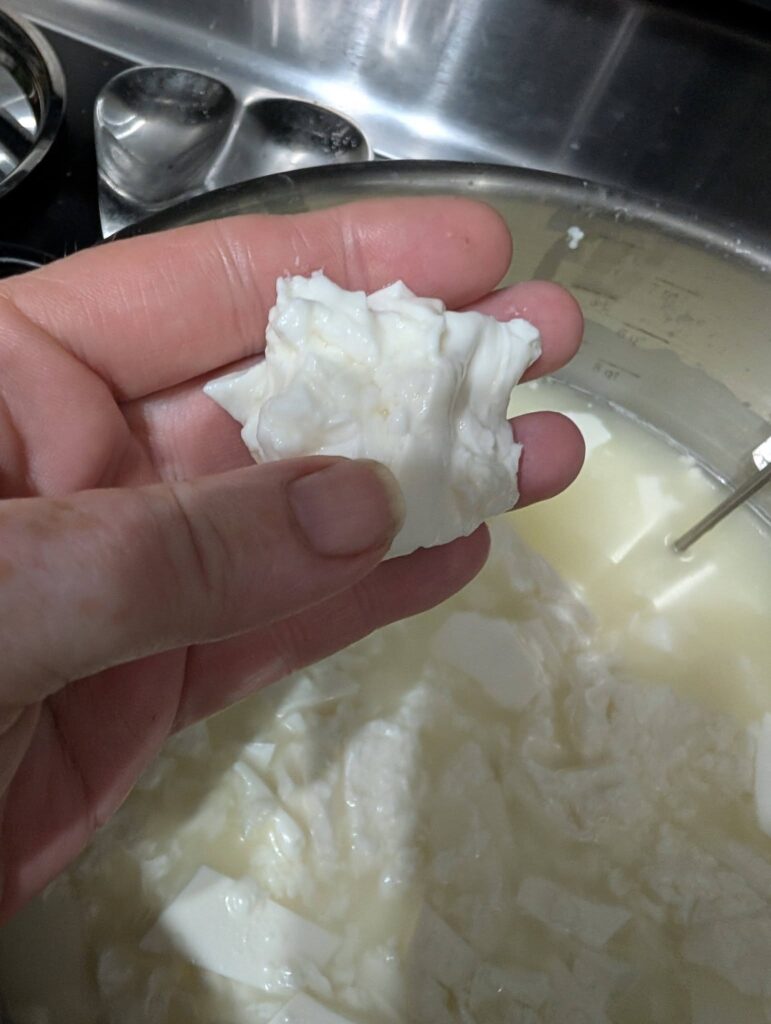
This is the step that gives cottage cheese its texture.
Raise the temperature very gradually to 115°F over 40 to 90 minutes.
Stir gently the whole time, but not constantly, think “nudging,” not mixing. Just move it enough to keep hot spots from forming on the bottom of the pan.
Goat curds are delicate; the slow heating keeps them from dissolving.
Once at 115°F, hold it at that temp for 10 minutes.
Because cottage cheese curds are so delicate at most stages, you’ll want to recover and give the curds another 20 minutes off the heat to stabilize.
7. Drain
Gently ladle the cooked curds into a muslin‑lined colander.
Let drain 10–20 minutes depending on how dry you like them.
Optional: Rinse with cool water to remove whey acidity and firm the curds.
(Traditional cottage cheese does this; it gives a cleaner flavor. I do this with mine in the colander with non-chlorinated water by gently running it over the curds several times until it’s mostly running off clear)
8. Salt + cream
Transfer curds to a bowl.
Add:
• 1–2 tsp salt – sprinkle 1/3rd, gently stir, repeat 2 more times. Let the salt bloom for 10 minutes.
• Dress with cream to taste – you can use goat or cow crème, heavy cream, half and half or milk – however you like it.
Stir gently.
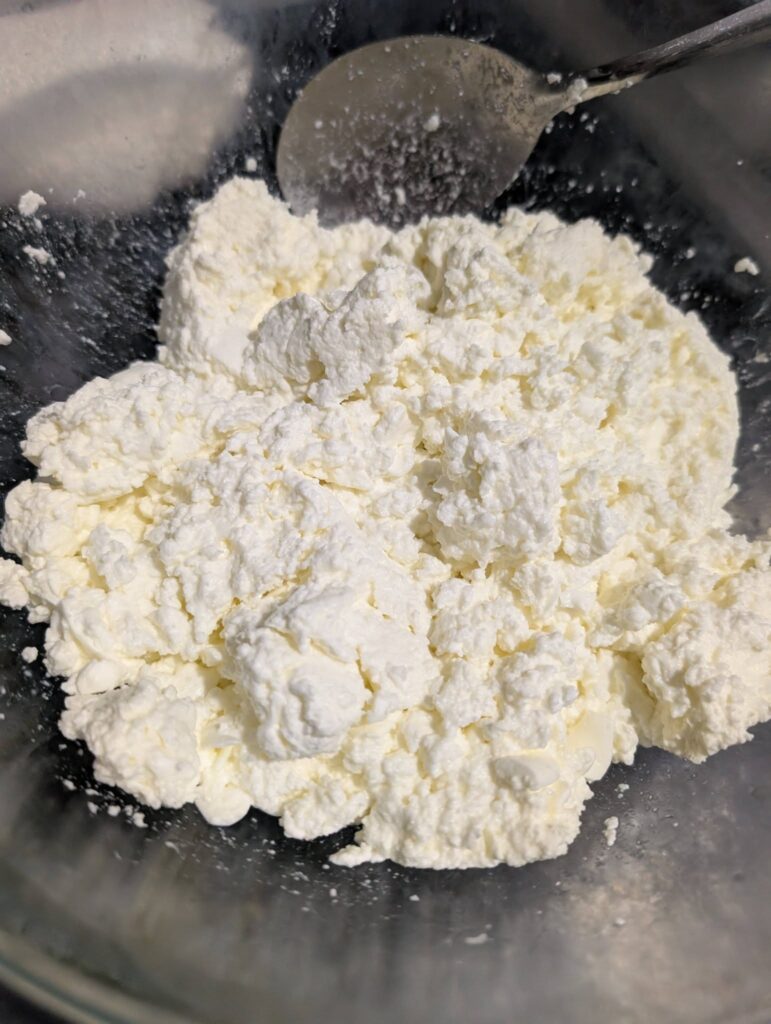
9. Refrigerate overnight
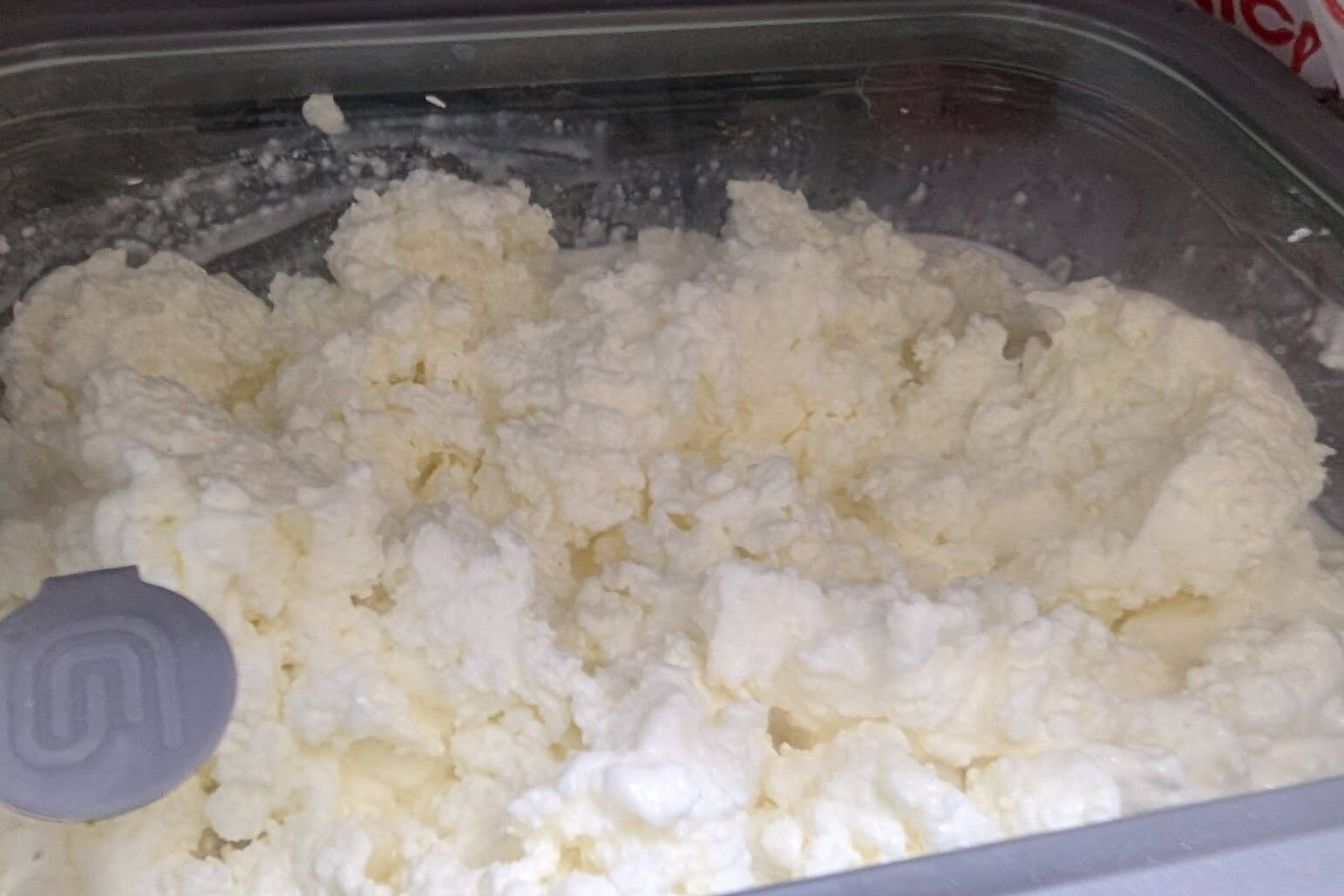
The cream and salt will fully integrate into the curds as they cool. Once absorbed into the cheese the flavor stabilizers and matures.
🌟 Texture Notes (Goat‑Milk Specific)
Curds will be softer and more tender than cow‑milk cottage cheese.
If you want firmer curds next time, increase rennet to 3 drops.
If you want softer curds, reduce to 1 drop.
Flora Danica culture also works for cottage cheese giving it a lighter more cloudlike finish.
🍽️ What you’ll get
Goat‑milk cottage cheese and store‑bought cow‑milk cottage cheese may share a name, but they’re almost different foods. Goat milk creates a naturally finer, more delicate curd with a soft, custardy texture and a gentle sweetness that comes from its smaller fat globules and clean, bright flavor profile. It tends to be creamy even before adding cream, and it never develops the firm, squeaky bite that cow‑milk curds do. Store‑bought cow‑milk cottage cheese, by contrast, is usually firmer, tangier, and more uniform because it’s made with higher‑acid cultures, stabilizers, and industrial processing that drive out more whey. The result is a product that’s thicker and more structured, but often less nuanced. Goat‑milk cottage cheese feels alive and tender, with a flavor that reflects the milk itself, while commercial cow‑milk versions lean on acidity and additives to create consistency.
So, if you handed someone a bowl of goat milk cottage cheese would they recognize it as cottage cheese? Yes, most people would recognize it as cottage cheese, but they’d also pause for a second because it doesn’t behave like the store‑bought version they’re used to.
Here’s how that usually plays out:
• Visually, goat‑milk cottage cheese still looks like cottage cheese: soft white curds, creamy dressing, spoonable texture. Nothing about it screams “mystery dairy product.”
• Goat milk curds are softer and more delicate, so someone used to the firmer, rubbery cow‑milk curds might think, “Oh, this is a different style of cottage cheese.”
• The flavor is the biggest surprise. Instead of tangy and salty, it’s sweet, clean, and milky. People often say it tastes “fresher” or “more like milk and less like cheese.”
• The creaminess throws people off in a good way. Goat‑milk curds feel almost luxurious compared to the industrial versions.
So yes, they’d recognize it.
But they’d also realize immediately that it’s a better, fresher, more expressive version of cottage cheese than anything they’ve bought in a tub.
If you handed someone a bowl and didn’t say a word, the reaction would probably be something like:
“Oh wow… this is cottage cheese? Why is it so good?”
So in the end you will have a bowl of:
• soft, custard-like curds
• clean, bright, sweet goat‑milk flavor
• a texture halfway between cow’s cottage cheese and farmer cheese
• absolutely perfect with fruit, herbs, or a drizzle of olive oil
🥣 Version 2: No‑Culture Cottage Cheese (Acid‑Set)
Beginner‑friendly, fast, and perfect for anyone who wants to try cheesemaking without special ingredients.
This version is simple, pure, and surprisingly elegant. The curds are softer and more delicate than the cultured version, almost cloud‑like, and the flavor is mild and fresh.
Ingredients (1 gallon)
- 1 gallon goat milk
- 1/4 cup white vinegar or lemon juice (you may not need all of it)
- 1–1.5 tsp salt
- Cream or half‑and‑half for dressing
Process
- Heat the milk
Warm to 180°F, stirring occasionally.
Turn off the heat.
- Add the acid slowly
Add vinegar or lemon juice 1 tablespoon at a time, stirring gently.
Stop as soon as curds separate cleanly and the whey turns yellowish.
- Rest
Let sit 10 minutes undisturbed.
- Drain
Pour into a muslin‑lined colander.
Drain 10–20 minutes.
Optional: rinse with cool water to remove excess acidity.
- Salt + cream
Salt to taste and add cream until it reaches your preferred texture.
What you get: A soft, tender, mild cottage cheese that tastes like fresh milk and sunshine, perfect for beginners, kids, or anyone who wants a quick, satisfying cheese.
🌿 Which One Should You Make?
- If you want distinct curds, mild tang, and a classic cottage‑cheese feel go with the cultured, rennet‑set version.
- If you want something fast, simple, and beginner‑friendly, try the acid‑set version.
- If you’re swimming in milk (as we often are) make both and taste them side by side.
Goat milk expresses itself differently in each method, and it’s a joy to discover what your herd’s milk wants to become.
🐐 The Heart of It All
Cottage cheese is one of those cheeses that reminds you why small‑scale dairying matters. It’s humble, nourishing, and deeply tied to the rhythm of the day. When you make it with milk from animals you know, animals who nuzzle your pockets and watch you from the pasture, it becomes more than food.
It becomes a conversation between you and the farm and that conversation is always evolving.
